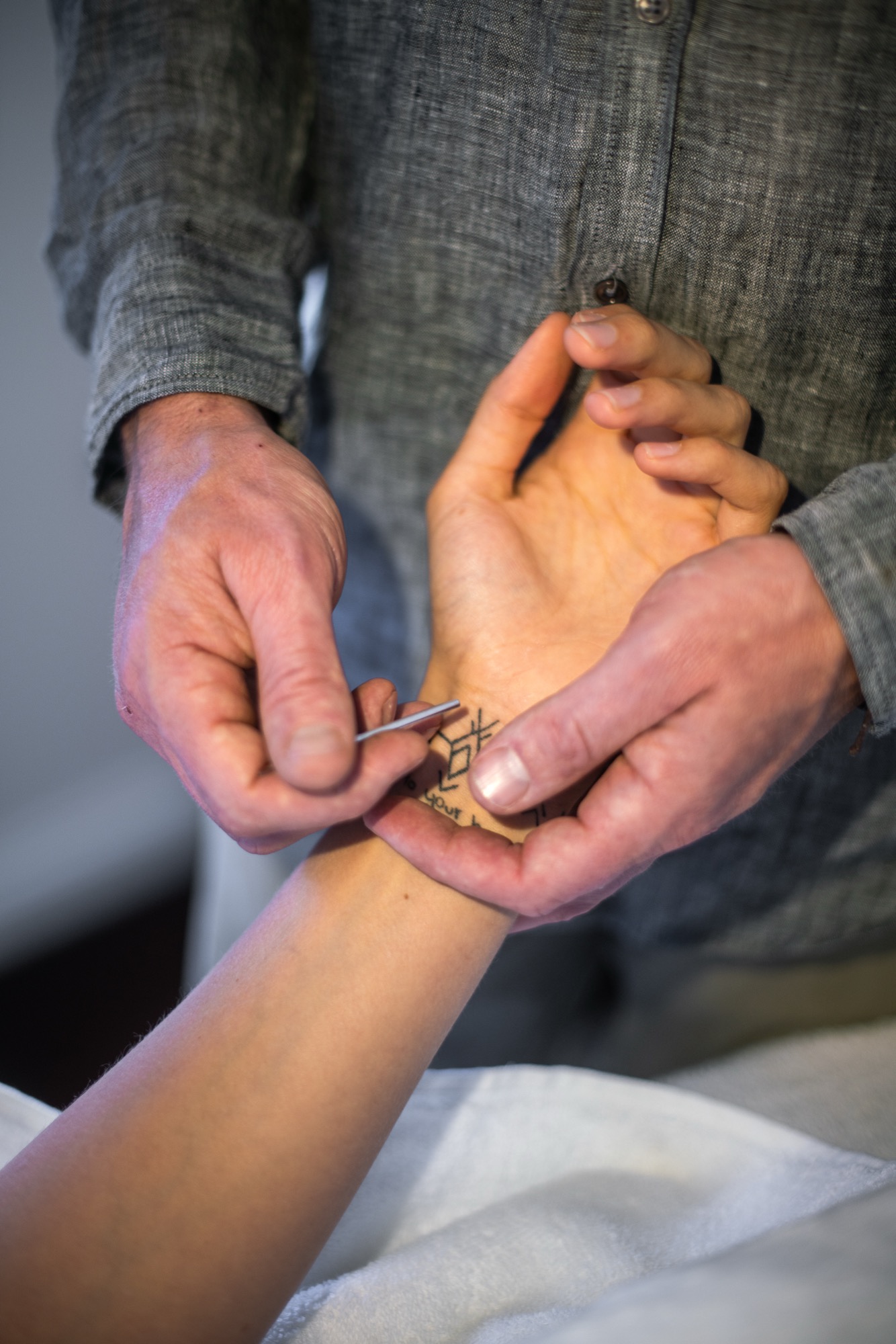
Classical Japanese Acupuncture needling at the wrist
The method

Classical Japanese
Acupuncture.

Finer needles, lighter touch, fewer needles, more precise. A different tradition, chosen deliberately.

A different tradition

Most people picture acupuncture as a fairly uniform thing — needles, points, done. In practice, the styles vary enormously, and the differences matter. Chinese-style acupuncture, the style most familiar in the West, tends to use thicker needles and a firmer, more deliberate insertion. It's effective, and it's the version most clinics teach.

Classical Japanese Acupuncture takes a different route entirely. The needles are finer — often a fraction of the diameter — and the touch is lighter. Fewer needles are used, inserted with greater precision, often to a shallower depth. The aim isn't to do less. It's to do exactly what's needed, no more, and to do it with enough sensitivity that the practitioner can feel the body's response in real time and adjust accordingly.

For many people, especially those who've avoided acupuncture out of needle phobia or a bad first experience, this is the difference that changes everything. Less intimidating. Just as effective, often more so. Fully intentional.

The needle is a conduit, not the treatment itself.

That's the philosophy underneath the technique. The needle doesn't do the work on its own — it's the means by which a calm, attentive practitioner reads and responds to what the body is communicating. Remove the attunement, and you're left with a fairly mechanical act. Keep it, and the same needle becomes something closer to a conversation.

The lineage

Ross trained under the lineage of Master Ikeda Masakazu, a teacher whose approach to Classical Japanese Acupuncture emphasises exactly this — precision over force, sensitivity over routine. It's a demanding way to learn, because it asks the practitioner to develop a kind of perception that can't be rushed or substituted with technique alone.

Ross chose this tradition specifically, rather than falling into it by default. His background in Qigong and Kung Fu had already trained him to notice subtle shifts in tension, breath and posture — the kind of signals a louder, more forceful style of treatment tends to miss. Classical Japanese Acupuncture was the discipline that matched the way he already understood the body. It wasn't a stylistic preference. It was the tradition built for the kind of attention he already knew how to give.

There's a deeper pattern in how Ross approaches all of this — the same instinct for noticing structure and relationship that shows up whether he's reading a pulse, a stance, or the layout of an old building. He'd be the first to say the body keeps its own kind of record, if you know how to read it.

Ready when you are

Book a session with Ross

Tuesdays · Thursdays · Saturdays · Soul Song Temple, Nambour QLD
Seniors receive a 10% discount · Financial hardship support available — just ask

Book Online